
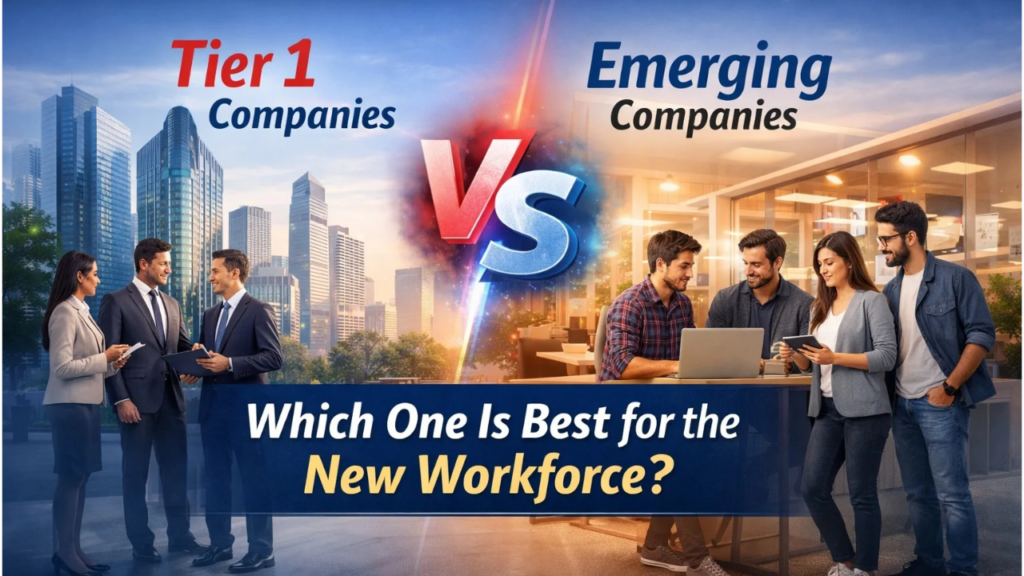
Tier 1 vs Emerging Companies: Which one is Best for New Workforce
Overview
For decades, working in a Tier 1 company was widely considered to be the safest and rational choice for anyone’s career. In fact, societies like India forces its youngsters to work only in tier-1 companies that usually offer structured growth and stability.
At the same time, emerging companies were often viewed as high-risk and uncertain career choices. Usually limited to people who could not join tier 1 companies or looking for a huge salary package.
The situation has changed worldwide.
Due to the fast-paced technical revolution, professionals are leaning towards gaining more skills and experience rather than sticking with any stable organization. Nowadays, career value is measured not only by organizational prestige but by the learning curve and work satisfaction of an employee.
Though, larger organizations or Tier 1 companies are still offering stability with its long history, but emerging companies are also offering a wide range of advantages to its workforce.
Tier-I Companies: Scale, Structure, and Strength
Tier 1 companies are the biggest companies in any sector or industry. They are built to operate at scale and deliver consistent outcomes over long periods of time. Reliability and repeatability are their biggest strengths.
Where Tier-I Companies Create Real Value
1. Operational Stability and Governance
Large organizations are known for their operational stability and governance as they are specially designed to survive volatility. They typically have established revenue streams, compliance frameworks, and layered design making to ensure continuity even during industry-wide economic hardship.
2. Clearly Defined Roles and Expectations
Tier 1 companies usually excel at role clarity that includes job responsibilities, reporting structures, performance metrics, and promotion criteria. All these things are well documented that reduces ambiguity.
3. Structured Learning and Standardization
Large organizations also offer training programs, internal certificates, and process documentation to ensure consistency of knowledge and execution. This can be a valuable lesson for early professionals.

Emerging Companies: Learning, Ownership, and Career Compounding
Emerging companies operate in totally different conditions compared to a tier one organization. They are built and known for their speed, experimentation and adaptation. Most of these companies operate on momentum.
What Emerging Companies Do Differently
1. Faster and Broader Learning
Compared to a tier-one organization, roles in most emerging companies are usually not confined to a single function. Team members are made aware of strategy, execution steps in the organisation at every phase, and customer realities regardless of their role.
In fact, 57% of Gen-z employees believe upskilling is far more important in career growth compared to salary hike or promotion. That percentage shoots to 87% when we talk about the professionals in creative fields such as Arts, Animation, etc.
2. Clear Ownership and Visibility
Compared to a Tier 1 organization, ownership of any project or task is clearly visible in an emerging company. Individual contributors are more appreciated in these organizations for their good job. This results in clear accountability that can accelerate professional maturity.
3. Faster Feedback and Execution
In emerging organizations, ideas move quickly from discussion to implementation. A creative professional or a high-performing professional with new ideas don’t have to wait or follow a certain procedure to pitch their ideas. Emerging organizations fast at adapting new ideas as they usually run on momentum.
Experience ServiceNow the right way with Avatu
Avatu: An Example of an Evolving, Emerging Company
Avatu is a prime example of an emerging company that is bridging the gap between agility and structure. We use a unique approach where growth is pursued without sacrificing clarity, accountability, or professionalism.
Key aspects of
Avatu’s operating model include:
- Clear expectations and ownership without unnecessary bureaucracy for Structured Flexibility.
- Emphasis on market relevant skills rather than hierarchical progression for skill first career development.
- Open communication around priorities, performance, and growth paths for transparency in decisions.
- Team members are encouraged to think beyond job descriptions and contribute to ownership-oriented culture.
We believe career growth and security comes from skill relevance, ownership and adaptability not from the organization’s size alone. Learning is the true path to stay relevant and thrive in today’s fast pacing technological world.
Avatu encourages its employees to build market-facing relevant skills that compound over time that ensures professional growth as technologies and roles change.
Conclusion: Best-Fit, and Best-Evolving
Tier 1 companies are good at providing career security with its well-defined processes, but emerging companies are also catching up. Organizations such as Avatu prioritize skill relevance, ownership, and adaptability over tenures and titles when it comes to growth.
In today’s environment where most of the workforce is young individuals, these professionals are looking for what fits best for their goals.
Yes, Tier 1 organisations are still leading the industry and are the default choice of newbies, but emerging companies are also offering faster growth versatile skill development, and holistic experience of real-life working environments.
The choice between a Tier-I company and an emerging company should no longer be driven by size or legacy alone. It should be guided by modern career values such as work satisfaction, continuous learning, and long-term skill relevance.
Both options are the best provided the professional knows the reason of joining them. Tier 1 companies offer stability and has well defined process, while emerging company offers holistic experience for long term career growth and career security.
Turn go-live into lasting business success with Avatu’s tailored Automation solutions!